The Best ERP System for Small and Medium-Sized Enterprises in the UAE

The Best ERP System for Small and Medium-Sized Enterprises in the UAE
Small and medium-sized enterprises (SMEs) in the UAE now operate in a fast-paced business environment that leaves little time for correcting management errors or delaying decisions. Customers expect immediate responses, competition is constantly increasing, branches and sales channels are expanding, and financial and tax requirements now demand accurate and readily accessible data.
At the start of a business, relying on simple accounting software and a few Excel spreadsheets may suffice to manage sales, expenses, and inventory. However, as the number of customers, employees, orders, and suppliers grows, information begins to fragment across different systems. The sales department keeps its data in one program, the warehouse tracks quantities via a separate file, and the accounting department uses yet another system, while approvals and orders remain scattered across email and chat applications.
The problem here is not a lack of software, but rather the absence of a unified system that interconnects operations. A company might use five different software programs yet still be forced to manually enter data multiple times, reconcile figures across departments, and wait for reports just to understand what is happening within the business.
Therefore, the search for... has become... The Best ERP System for Small and Medium-Sized Enterprises in the UAE This is a crucial step for any organization looking to streamline its operations and prepare for growth. However, "the best" does not mean choosing the most famous software on the market or the system with the most features; rather, it means selecting the system that truly aligns with the company’s size, nature of business, budget, and expansion plan.
The system suitable for a trading and distribution company with three warehouses differs from the system suitable for a consultancy firm that operates based on projects and billable hours. Likewise, the needs of an online store are not the same as those of a factory, a clinic, or an educational institution.
In this article, we review the key criteria for selecting an ERP system for small and medium-sized enterprises (SMEs) in the UAE, compare the leading systems available, identify the most suitable system for each sector, outline the factors determining costs, and highlight common implementation mistakes to avoid.
What is an ERP system for small and medium-sized enterprises?
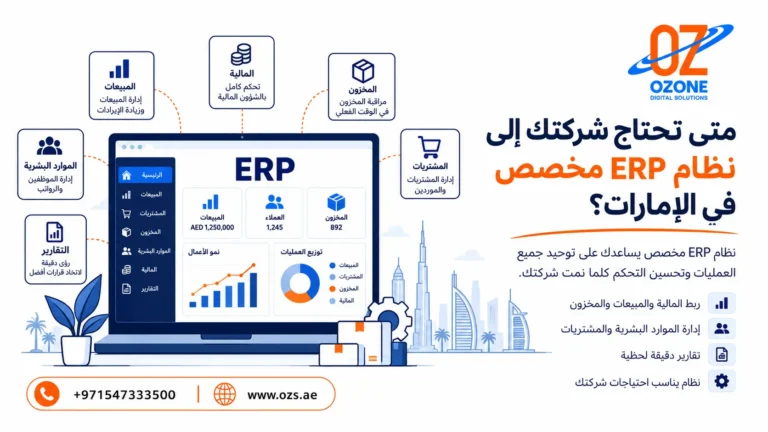
نظام ERP، Enterprise Resource Planning (ERP) is a software platform that connects a company's core operations within a single database. This encompasses accounting, sales, purchasing, inventory, human resources, projects, customer service, production, and reporting.
When the system operates in an integrated manner, there is no need for each department to create a separate copy of the data. When a sales representative places a new order, the system can simultaneously update inventory, generate a fulfillment order, issue an invoice, record the amount owed by the customer, and update sales and accounting reports.
The goal of the system is not to impose an additional administrative burden on employees, but rather to reduce manual steps and streamline workflows across departments. Through a unified database, management obtains more accurate data, and each employee can access the information they need based on their level of authorization.
The ERP system intended for small and medium-sized companies is usually more flexible and less complex than the large systems used in global institutions. You can start with a limited number of modules, such as accounts, sales, and inventory, and then add human resources, projects, or manufacturing as the facility grows.
Microsoft explains that Dynamics 365 Business Central is designed specifically for small and medium-sized businesses, offering financial, sales, project, and supply chain management, alongside integration with Microsoft 365 applications and real-time analytics.
SAP also offers Business One as a management solution for small and medium-sized enterprises, covering accounting, purchasing, inventory, sales, customer relations, reporting, and analytics.
Why do small and medium-sized enterprises need ERP?
Some business owners may believe that an ERP system becomes necessary only after a company has grown significantly. In reality, however, small and medium-sized enterprises have the greatest need to organize their resources, as they typically operate with limited teams and cannot afford wasted time or repeated errors.
A large organization may have a larger number of employees to handle issues manually, whereas a small business owner needs to run operations with high efficiency using a limited team.
As part of its e-invoicing program, the UAE Ministry of Finance notes that 82% of companies in the country are classified as micro-enterprises with an annual turnover of less than AED 3 million, emphasizing the importance of making automation and streamlining technologies available to this segment at an affordable cost.
Consolidating company data
When an organization uses multiple disconnected software systems, each department becomes responsible for updating its own data. A sales employee might record an order, only for the accounting department to re-enter it, and a warehouse worker to subsequently transfer it to a third file.
This method not only consumes time but also increases the likelihood of errors and redundancy. For instance, a product might appear available in the sales records while actually being out of stock in the warehouse, or an invoice might be issued for an amount that differs from the approved price quote.
An ERP system provides the company with a unified source of information. When data changes in one location, the result is reflected across the relevant departments in accordance with established workflows.
Improving financial oversight
A small business needs a clear view of cash flows, outstanding receivables, expenses, and project profitability. Sales may be high, yet liquidity remains weak due to delayed collections, inventory buildup, or unplanned expenses.
through SystemsManagement can track accounts receivable and payable, due dates, collection status, expenses by department or project, and projected cash flows.
Managing growth without increasing chaos
Growth is not always an indicator of operational efficiency. Sales may rise, but so do errors, complaints, and delays. When processes lack organization, every new customer becomes an additional strain on the team.
The system helps establish clear steps for each process—such as approving a price quote, fulfilling a purchase order, preparing a shipment, or issuing an invoice. This enables the company to increase its business volume without a corresponding rise in disarray.
Support for multiple branches and warehouses
Many businesses start with a single branch and subsequently expand within Dubai, Abu Dhabi, Sharjah, or the other emirates. Over time, management needs to compare sales, expenses, and inventory across the various locations.
The appropriate system enables the management of multiple branches or warehouses from a centralized dashboard, with the ability to define independent access rights and generate separate or consolidated reports.
Preparing for digital requirements within the UAE
The business environment in the UAE is moving towards greater automation and the exchange of structured data. The Ministry of Finance clarifies that an e-invoice is not merely a PDF file sent via email; rather, it consists of structured data that is issued and exchanged electronically and reported to the Federal Tax Authority through the approved system.
Therefore, the choice of an ERP system should not be limited to current needs. It is best to ensure the system’s ability to integrate with authorized service providers, update financial and tax fields, and exchange data via secure APIs.
What is meant by the best ERP system?
There is no single system that can be considered the best for all companies. The right choice depends on how well the system aligns with the organization's needs, rather than the number of features listed on the product page.
A system might be powerful and globally used, yet exceed the needs of a small company, thereby driving up costs and complicating employee training. Conversely, another system might be simple and user-friendly but fail to support manufacturing, multi-company operations, or complex processes.
Therefore, it can be defined as The Best ERP System for Small and Medium-Sized Enterprises It is the system that achieves a balance among seven elements:
Coverage of core operations, ease of use, customizability, integration with other systems, total cost, local support, and scalability.
The system should not be evaluated based solely on the demonstration, as most systems appear easy when presented by an experienced employee using ideal data. The true test lies in executing day-to-day business operations within the system—such as creating a sales order, processing a product return, transferring inventory, approving an expense, or generating a profitability report.
Key Criteria for Selecting an ERP System in the UAE
Alignment of the system with the nature of the activity
Start with the processes that generate revenue for the company or cause it the most problems.
If the company operates in trade and distribution, the focus should be on inventory, purchasing, sales, pricing, and warehousing. If it operates in the service sector, the management of projects, contracts, working hours, and billing becomes more important.
As for factories, they require production orders, bills of materials, requirements planning, quality control, and manufacturing cost calculation.
The closer the system is to the nature of the company's operations, the less need there is for complex modifications.
Support for Arabic and English
Companies in the UAE operate within a multilingual environment; the management team may use Arabic, while the accounting or operations team relies on English.
Therefore, it is important for the system to properly support both languages, including interface direction, document printing, field names, invoices, and reports.
It is not enough for the menus to be translated; actual invoices, reports, and documents must be tested to ensure the Arabic text appears without errors or overlapping.
Support for the Dirham and multiple currencies
The company may operate in UAE dirhams, yet it purchases from suppliers in US dollars, euros, or Saudi riyals, or sells to customers across various Gulf markets.
The system must allow for recording exchange rates, revaluing balances, generating reports in the base currency, and managing multi-currency accounts.
Tax and Financial Data Management
It is essential to ensure that the system is capable of generating invoices, accounting entries, and reports tailored to the organization's needs, supporting Value Added Tax (VAT), and maintaining records and documents in an organized manner.
However, one should not rely on the phrase "tax-compliant" without verification. Compliance depends not only on the software itself but also on the setup, data accuracy, and the procedures implemented by the company.
Furthermore, the system does not replace the accountant or tax advisor; rather, it provides them with more organized data and facilitates the preparation of reports and audits.
Preparing for E-invoicing
With the evolution of the e-invoicing program in the UAE and the issuance of regulatory decisions and legislation during 2025 and 2026, it has become essential to select a system capable of connecting to an accredited service provider and exchanging structured invoice data.
Ask the system provider about integration interfaces, the invoicing data structure, and the system's ability to be updated when requirements change—rather than focusing solely on its capacity to generate PDF invoices.
Ease of use
Small and medium-sized enterprises do not always have large technical teams; therefore, the system must be clear to the average employee.
Every unnecessary extra step reduces the likelihood of the team adhering to the system. If an employee has to open multiple screens to perform a simple task, they might revert to using Excel or WhatsApp.
Test the system with the employees who will actually use it, not just with management. A company manager might need a dashboard, whereas a warehouse worker needs a fast interface for receiving, issuing, and barcode scanning.
Customizability
No two operations function in exactly the same way. A company might require specific approval workflows, particular reports, additional fields, or integration with an external platform.
The system must allow for an appropriate degree of customization, without turning every modification into a lengthy software project.
Flexible systems typically offer low-code settings, workflows, and tools, whereas more complex modifications require a dedicated development team.
Integrability
A company may need to integrate its ERP system with an online store, mobile app, payment gateway, shipping provider, attendance system, or CRM platform.
Evaluate the quality of the APIs, the documentation, the authentication method, and the data update rate. Simply having an API does not guarantee that integration will be easy or comprehensive.
Security and Permissions
The system contains sensitive financial and commercial data; therefore, it must implement role-based access controls, audit logs for modifications, backups, encryption, and multi-factor authentication.
Segregation of duties must also be implemented; an employee who creates a new vendor should not have sole authority to approve payments to that vendor.
Reporting & Advanced Analytics
A good system does not merely record transactions; it transforms them into usable information.
Ensure visibility into daily sales, product profitability, branch performance, stagnant inventory, overdue amounts, project costs, and cash flows.
Do not rely solely on the number of ready-made reports. What matters most is the ability to customize them and link them to the performance indicators that are important to management.
Local Support
The system may be global, but its success within the UAE depends largely on the partner implementing and supporting it.
A local partner typically understands market needs, the language, the nature of invoicing and taxes, working hours, and how to communicate with teams.
Before signing a contract, ask about response times and support channels, and whether the support covers only errors or also includes usability improvements and reporting.
Best ERP Systems for Small and Medium-Sized Enterprises in the UAE
There are many options on the market, but the following systems are among the most notable solutions for UAE companies to consider. Their ranking does not imply an absolute judgment; rather, it highlights the most suitable use case for each system.
First: The Odoo System
Odoo is one of the most flexible options for small and medium-sized enterprises, particularly for businesses that wish to start with a limited number of modules and then expand gradually.
The system relies on a suite of interconnected applications covering accounting, invoicing, sales, customer management, point of sale (POS), inventory, purchasing, manufacturing, project management, human resources, marketing, websites, and online stores.
Why might Odoo be a suitable choice?
The key feature is the flexible structure. A business can start with sales, accounting, and inventory, and then add an online store, manufacturing, or human resources as it grows.
The system also allows for customization through settings, the Studio tool, or software development, making it suitable for companies with specialized processes that simple accounting software does not cover.
Having the website, store, points of sale, and customer management within the same environment helps some companies reduce the number of systems and integrations they require.
Companies best suited to use it
Odoo is suitable for trading and distribution companies, online stores, restaurants, service providers, and organizations that require CRM, sales, inventory, and accounting capabilities within a single platform.
It can also be configured for manufacturing, maintenance management, and quality control; however, it requires professional analysis and implementation when processes are complex.
Points to consider
System flexibility can become a problem if the project is implemented without proper controls; the implementation team might introduce numerous modifications that make updating and maintenance more difficult.
Therefore, one should start with the core operations, rely as much as possible on standard functions, and develop custom features only when they offer clear operational value.
The quality of the experience also depends significantly on the implementing partner's expertise and the way accounts, inventory, and permissions are configured.
Secondly: Microsoft Dynamics 365 Business Central
Business Central is a strong choice for small or medium-sized businesses that have organized processes and make extensive use of the Microsoft environment.
Microsoft describes the system as an AI-powered ERP for small and medium-sized businesses, covering financial management, sales, services, projects, inventory, supply chains, and manufacturing, with integration with Outlook, Excel, Teams, and Power BI.
Why might it be suitable?
Companies that rely on Microsoft 365 can benefit from the integration between the system and the tools that employees use every day.
Teams can analyze data through Excel and Power BI, share project information within Teams, and connect Sales and Operations to other applications in the Microsoft environment.
The system supports multiple currencies, languages, companies, and inter-company transactions, making it suitable for enterprises planning to expand within the UAE or internationally.
Companies best suited to use it
Suitable for trading, distribution, professional services, enterprise, and light and medium manufacturing companies, especially when the company has a structured finance team and strong reporting needs.
It is also suitable for organizations that want to benefit from the Microsoft ecosystem, artificial intelligence, analytics and automation.
Points to consider
The system may be larger than the needs of a very small company, and its success depends on choosing the right partner and controlling the scope.
Customizations and integrations may raise the cost, so you must determine what the company actually needs, and not purchase advanced modules that will not be used.
Third: Oracle NetSuite
NetSuite is a cloud-based ERP system suitable for fast-growing medium-sized companies and organizations that manage multiple companies or branches.
The system provides financial management, inventory, orders, purchasing, warehouses, supply chains, global business management and reporting, along with CRM and project management tools.
Why might it be suitable?
One of the strongest aspects of NetSuite is its ability to manage multiple companies, branches, currencies, and financial requirements within a unified cloud platform.
NetSuite explains that the OneWorld platform helps companies manage global operations, including currencies, tax rules and reporting requirements across countries and subsidiaries, with real-time financial consolidation.
The system also provides powerful functionality for multi-location inventory, order management, warehouse, purchasing, and financial reporting.
Companies best suited to use it
It is suitable for rapidly growing mid-sized companies, multi-entity groups, trading and distribution firms, and professional and technical service providers that require advanced financial and project management capabilities.
It could be suitable for an Emirati entity planning to open subsidiaries in multiple countries and requiring consolidated financial reports.
Points to consider
NetSuite can be costly and complex for small businesses with limited operations. The company explains that licensing comprises the core platform, add-on modules, and the number of users, in addition to an initial implementation cost.
لذلك يجب حساب التكلفة الكلية لعدة سنوات، وليس تكلفة الاشتراك الأولية فقط.
Fourth: SAP Business One
SAP Business One is a customized solution for small and medium businesses that need an organized system to manage accounts, sales, purchasing, inventory, customer relations, and reports.
SAP describes the system as a single ERP solution for managing the entire company, with real-time information, business intelligence, scalability and customization.
Why might it be suitable?
The system has a robust architecture for financial and business processes, and is typically used in distribution, manufacturing and trading companies that need close control of inventory, purchases and sales.
It can also be customized and expanded as the organization grows, and enables mobile access depending on the deployment method used.
Companies best suited to use it
Suitable for small, stable companies and medium-sized companies with more complex operations, especially in trade, distribution and manufacturing.
It may be a suitable option for companies affiliated with groups that use SAP products or want an enterprise-class operational structure.
Points to consider
The system requires an experienced implementation partner, and the cost of implementation and support may be higher than simpler solutions.
The interface should also be tested with employees, and the cost of required additions, integrations, and reports reviewed.
Fifth: ERPNext
ERPNext is an open source system that can suit small and medium businesses looking for flexibility and greater system and cost control.
Covers accounting, billing, sales, purchasing, inventory, manufacturing, projects, point of sale, human resources, and payroll, and provides low-programming tools for customizing forms, reports, and approval paths.
Why might it be suitable?
The fact that the system is open source gives the company flexibility in hosting and development and reduces the complete connection to one provider.
It also supports multiple companies and currencies, permissions, approval paths, and integration APIs.
Frappe explains that ERPNext was designed with the needs of small and medium-sized enterprises in mind; its hosted version does not rely on per-user fees, but rather ties costs to hosting resources and the required services.
Companies best suited to use it
It is suitable for companies with a carefully planned budget that require an integrated, customizable system—such as service providers, trading companies, light manufacturing firms, and educational institutions.
It is also suitable for organizations that have a technical team or development partner capable of managing customizations and updates.
Points to consider
Open source software is not completely free. The company needs hosting, implementation, training, maintenance, backup and security.
It is also essential to ensure that financial and tax requirements are correctly configured, and not to assume that general settings suit every aspect of business operations in the UAE.
Sixth: Zoho One
Zoho One is not always classified as a traditional, full-fledged ERP system, but it represents a practical option for some small businesses that need an interconnected suite of applications to manage customers, sales, accounting, employees, projects, support, and marketing.
Zoho explains that the platform includes more than 45 interconnected applications and helps growing companies manage customers, employees, operations and financial data within a unified environment.
Why might it be suitable?
Zoho One may be suitable for a service-based or digital company that does not deal with inventory or complex manufacturing, yet requires CRM, accounting, project management, HR, support, and marketing capabilities.
The platform offers customization, automation, and integration capabilities with other applications, alongside centralized management of users and permissions.
Companies best suited to use it
Suitable for marketing agencies, consulting companies, technology, professional services, and some startups.
It can also be a good transitional stage between using separate tools and a more specialized ERP implementation.
Points to consider
As inventory, manufacturing, warehouse, or management accounting operations become more complex, a facility may need specialized ERP or additional integrations.
It is also necessary to examine the licensing approach for all employees and ensure that the company will utilize a sufficient number of applications to deliver real value.
Seventh: A dedicated ERP system
In some cases, an off-the-shelf system is not the best solution. The company may have a unique business model, or operational procedures that represent its competitive advantage, or need integrations and user experiences that traditional systems do not provide.
Here a custom ERP system can be developed from scratch or special modules built around a stable basic platform.
When is a custom system appropriate?
It is appropriate when a company has to significantly change the way it operates to fit the software, when it needs processes not found in off-the-shelf solutions, or when long-term licenses and modifications are higher than the cost of building a custom solution.
It can also be utilized when the organization requires dedicated portals for customers and suppliers, field applications, pricing algorithms, or complex approval workflows.
Features of the customized system
Interfaces, workflows, and reports are designed according to the organization's needs, and the system can be directly integrated with the website, application, and external platforms.
The company can also control the development plan and add features according to its priorities.
Challenges
A customized system needs careful analysis, a reliable technical team, and a long-term maintenance plan. Without good documentation and testing, a company may become tied to one team or face problems when scaling.
Therefore, a custom system should not be developed simply because the company does not want to change a simple procedure. There must be clear operational value to justify the investment.
A brief comparison of the systems
Odoo can be seen as a flexible and balanced option for businesses that want a wide range of modules and high customizability.
Microsoft Business Central is suitable for organized companies that rely on the Microsoft ecosystem and require robust financial management, reporting, and integration capabilities.
NetSuite is suitable for fast-growing medium-sized enterprises and multi-entity and multi-market groups.
SAP Business One serves trading, distribution, and manufacturing companies that want a stable enterprise system.
ERPNext offers a flexible open source alternative for companies that have a technology partner capable of implementation and maintenance.
Meanwhile, Zoho One is well-suited for service-based and digital businesses that require a suite of interconnected business applications rather than complex inventory or manufacturing processes.
As for the customized system, it is appropriate when the facility’s procedures are unique and represent an essential part of its competitive advantage.
Best ERP by activity type
Trading and Distribution Companies
These companies need to manage multi-location inventory, purchasing, pricing, sales, returns, credit, and collections.
Odoo, Business Central, and SAP Business One can be suitable options, while NetSuite becomes stronger when a company expands into multiple entities or markets.
Emphasis should be placed on barcodes, tracking batches and serial numbers, reordering, moving inventory between warehouses, and profitability of products and customers.
Online stores
Stores need to link orders with inventory, payments, shipping, invoicing, and customer service.
Odoo may be suitable when a company wants to manage the store and ERP within a single environment, while Business Central provides Shopify integration and functionality to manage orders and inventory.
ERPNext or a custom system can also be linked to the store platform, depending on the volume of operations.
Service and Consulting Firms
The priority here is managing clients, projects, contracts, tasks, work hours, expenses, and invoices.
Zoho One or Odoo may be suitable for smaller companies, while Business Central and NetSuite are better suited for companies that need more advanced project accounting, analytics, and profitability.
Contracting companies
You need to manage budgets, procurement, subcontractors, labor, equipment, payment applications, and project costs.
It is not enough to choose a general accounting system. The entire project cycle must be experienced and ensure that cost centers, completion percentages, project-related procurement, and expenditure approval are supported.
Odoo or ERPNext (with specialized customization), Business Central or SAP Business One (via industry-specific add-ons), or a custom-built system—in cases of operational complexity—might be suitable options.
Factories
Factories require bills of materials, production orders, requirements planning, operational stages, quality control, maintenance, and cost calculation.
Odoo and ERPNext offer manufacturing functionalities within their platforms; Business Central provides production order and bill of materials management; and SAP Business One is used by small and medium-sized manufacturing companies.
But an actual experiment must be conducted with one of the company's products, because the phrase “manufacturing supports” may mean different levels of depth.
The health sector
Clinics and health centers need a clear separation between the medical system and the resource management system.
An ERP system can manage accounts, procurement, inventory, maintenance, personnel, and branches, while integrating with medical records and appointment scheduling systems.
Emphasis must be placed on privacy, access rights, access logs, and backups, while ensuring that not all employees have access to sensitive data.
Education and Training
Educational institutions benefit from the management of fees, expenses, staff, procurement, assets and branches.
The ERP can be linked to an educational platform or student management system. Odoo or ERPNext may be suitable for customization, while Zoho One is suitable for service training organizations with simpler processes.
Logistics services
Logistics companies need to manage orders, shipments, drivers, vehicles, warehouses, costs, and invoices.
The organization may require a custom system or a specialized add-on, as operations differ between international shipping, local delivery, and warehouse management.
Cloud or local system?
Most small and medium-sized companies benefit from cloud ERP, because it reduces the need to purchase servers and manage an internal technical infrastructure, and allows access from different branches and devices.
In many cloud solutions, updates and backups are also part of the service.
However, a cloud-based system requires a review of data hosting locations, encryption levels, recovery policies, service continuity, and data ownership upon contract termination.
As for the local system, it gives the company greater control over the servers, but it requires a technical team, maintenance, updating, security, and backup.
The presence of the system on-premises does not automatically mean that it is more secure. A professional cloud platform may be more secure than a local server that is not monitored or updated.
How much does ERP cost for SMEs?
It is not possible to set a single price, because the cost depends on the number of users, modules, branches, customizations, integrations, data volume, hosting and support.
The true cost includes licensing or subscription, analysis, implementation, data migration, development, training, support, and updates.
A particular system might appear low-priced, yet the cost of customizing and maintaining it is high. Another system might have a higher subscription fee, but it reduces the need for manual development.
Ask how much it will cost over three or five years, not just the first year.
It is also necessary to account for the time company staff will dedicate to the project, as data cleansing, testing, and training require genuine involvement from the departments.
Steps to choose the appropriate system
Start by identifying the reasons for the project. Do not simply write "We need an ERP system"; instead, pinpoint the specific issues: delayed reporting, poor inventory management, data duplication, collection difficulties, or a lack of project profitability.
Next, document current processes, identify what needs to be improved and what needs to be eliminated.
List basic requirements, choose three suitable systems, and have each provider implement real-world scenarios using operations close to your company.
Do not rely on the general view. Instead, perform a full workflow—such as creating a sales order, reserving inventory, approving a discount, issuing an invoice, and recording a payment—and then view the impact of the transaction in the reports.
Compare solutions on clear criteria including functionality, ease of use, cost, customization, integration, support, and security.
Before signing the contract, make sure to define the project scope, phases, responsibilities of both parties, and the mechanism for accepting deliverables and support after launch.
Common mistakes when choosing an ERP
The first mistake is to choose a system based only on price. A cheaper system may require years of manual labor for employees.
الخطأ الثاني هو شراء عدد كبير من الوحدات قبل تحديد الأولويات. الأفضل أن تبدأ الشركة بالعمليات الأكثر تأثيراً ثم تتوسع.
الخطأ الثالث هو تقليد النظام المستخدم لدى شركة أخرى. قد تعمل الشركتان في القطاع نفسه، لكن تختلف العمليات وحجم الفريق ونموذج المبيعات.
الخطأ الرابع هو تجاهل المستخدمين. إذا لم يشارك الموظفون في التحليل والاختبار، ستظهر مشكلات كثيرة بعد الإطلاق.
الخطأ الخامس هو نقل البيانات القديمة من دون تنظيف. تكرار العملاء والأصناف والأخطاء سيؤدي إلى تقارير غير دقيقة.
الخطأ السادس هو الإفراط في التخصيص. كل تعديل يرفع تكلفة المشروع والتحديث والصيانة.
الخطأ السابع هو عدم وضع خطة للدعم والتطوير بعد الإطلاق.
كيف يتم تنفيذ النظام بنجاح؟
يبدأ التنفيذ بتحليل العمليات وتحديد مؤشرات النجاح، ثم تصميم النظام والصلاحيات والتقارير.
بعد ذلك، تتم التهيئة والتطوير على مراحل، مع مراجعات دورية حتى يرى العميل التقدم ويعتمد المخرجات.
ثم تأتي مرحلة تنظيف البيانات ونقلها، يليها اختبار العمليات من البداية إلى النهاية.
بعد نجاح الاختبار، يتم تدريب كل فريق على المهام التي تخصه، ثم إطلاق النظام مع توفير دعم مكثف خلال الفترة الأولى.
ولا ينتهي المشروع عند الإطلاق. يجب مراجعة الأداء بعد شهر وثلاثة أشهر وستة أشهر، وتحديد العمليات التي تحتاج إلى تحسين أو أتمتة إضافية.
كيف تقيس نجاح ERP؟
حدد مؤشرات واضحة قبل المشروع، مثل الوقت المطلوب لإعداد التقرير المالي، وعدد أخطاء المخزون، ومدة اعتماد المشتريات، وقيمة الفواتير المتأخرة.
بعد الإطلاق، قارن النتائج الجديدة بالوضع السابق.
يمكن أن يظهر النجاح في تقليل وقت إغلاق الحسابات، وتحسين دقة المخزون، وتسريع التحصيل، وخفض الإدخال اليدوي، وزيادة عدد الطلبات التي يستطيع الفريق إدارتها.
كما تظهر فوائد أخرى في وضوح المسؤوليات، وتحسن الرقابة، وسهولة تدريب الموظفين الجدد، وتقليل الاعتماد على أشخاص محددين.
Frequently asked questions
ما أفضل نظام ERP للشركات الصغيرة في الإمارات؟
يعتمد ذلك على احتياجات الشركة. قد يكون Odoo أو ERPNext مناسباً للشركات التي تريد المرونة، بينما تناسب Zoho One الشركات الخدمية، وقد يناسب Business Central الشركات التي تعتمد على Microsoft وتحتاج إلى إدارة مالية متقدمة.
ما أفضل ERP للشركات المتوسطة؟
يمكن تقييم Business Central أو NetSuite أو SAP Business One أو Odoo، بحسب القطاع وعدد الفروع وحجم العمليات.
هل يوجد نظام ERP عربي؟
نعم، تدعم أنظمة عديدة اللغة العربية، كما يمكن تطوير نظام مخصص. لكن يجب تجربة الواجهة والمستندات والتقارير للتأكد من جودة الدعم.
هل يمكن البدء بوحدة واحدة؟
نعم، ويمكن أن تكون هذه أفضل طريقة. تبدأ الشركة بالحسابات والمبيعات أو المخزون، ثم تضيف الوحدات الأخرى تدريجياً.
هل يغني ERP عن برنامج المحاسبة؟
يحتوي ERP عادةً على وحدة محاسبية، وقد يغني عن البرنامج المنفصل إذا كانت الوحدة مناسبة وتمت تهيئتها بصورة صحيحة.
هل يمكن ربط النظام بالفوترة الإلكترونية؟
يمكن ذلك إذا كان النظام يوفر واجهات وبيانات منظمة قابلة للتكامل مع مزودي الخدمات المعتمدين. يجب مراجعة الجاهزية الفعلية مع فريق التنفيذ.
كم تستغرق عملية التنفيذ؟
قد يستغرق مشروع محدود عدة أسابيع، بينما تحتاج الأنظمة متعددة الفروع والوحدات إلى عدة أشهر. تعتمد المدة على جاهزية البيانات وسرعة اتخاذ القرارات وحجم التخصيص.
هل النظام المخصص أفضل من الجاهز؟
ليس دائماً. النظام الجاهز أسرع ويعتمد على وظائف مجربة، بينما يناسب النظام المخصص العمليات الفريدة. القرار يحتاج إلى تحليل للتكلفة والمخاطر والقيمة طويلة المدى.
هل يمكن نقل بيانات الإكسل؟
نعم، لكن يجب تنظيف الملفات وتوحيدها وإزالة التكرار قبل النقل.
هل يحتاج الموظفون إلى خبرة تقنية؟
لا يحتاج المستخدم العادي إلى خبرة برمجية، لكنه يحتاج إلى تدريب واضح وفهم للإجراءات والصلاحيات.
كيف تساعد أوزون على اختيار وتطوير نظام ERP؟
في أوزون للحلول الرقمية وتكنولوجيا المعلومات، لا نبدأ المشروع باقتراح برنامج جاهز قبل فهم نشاط الشركة. نبدأ بتحليل العمليات والأهداف والتحديات التي تواجه كل إدارة.
ندرس دورة المبيعات والمشتريات والمخزون والحسابات والموارد البشرية والمشروعات، ونحدد نقاط التعطيل والأعمال المتكررة والبيانات التي تحتاج الإدارة إلى رؤيتها.
بعد ذلك، نحدد الحل الأنسب: تهيئة منصة جاهزة، أو تطوير وحدات وتكاملات خاصة، أو بناء نظام مخصص عندما تكون طبيعة العمل فريدة.
تعتمد منهجيتنا على أربع مراحل واضحة تبدأ بالتحليل، ثم تصميم تجربة المستخدم والهيكل التقني، وبعدها التطوير والاختبار، ثم الإطلاق والتدريب والدعم.
نهتم بأن يكون النظام قابلاً للتوسع، وسهل الاستخدام، وآمناً، وقادراً على التكامل مع الموقع أو المتجر أو التطبيق أو الخدمات الخارجية.
كما نركز على التقارير التي تخدم القرار، وليس مجرد إضافة عدد كبير من الشاشات والخصائص.
لماذا تختار أوزون؟
تمتلك OZONE خبرة في البرمجيات والحلول الرقمية منذ عام 2017، مع فهم لاحتياجات السوق الإماراتي والخليجي.
يعمل داخل كل مشروع فريق يجمع بين تحليل الأعمال والبرمجة والتصميم والاختبار والدعم، ما يساعد على تحويل الاحتياجات التشغيلية إلى نظام واضح وقابل للاستخدام.
لا نعتمد على القوالب باعتبارها حلاً لجميع الشركات. نحدد ما يناسب كل منشأة، ونبني أو نخصص النظام وفق أولوياتها.
كما تستمر الشراكة بعد الإطلاق من خلال الدعم والصيانة والتحسينات، لأن نظام ERP يجب أن ينمو مع الشركة ولا يتوقف عند لحظة التسليم.
الخاتمة
اختيار أفضل نظام ERP للشركات الصغيرة والمتوسطة في الإمارات لا يبدأ من مقارنة أسماء البرامج، بل من فهم الشركة نفسها.
النظام الأفضل هو الذي يحل المشكلات الفعلية، ويناسب طريقة العمل، ويستطيع الموظفون استخدامه، ويدعم التوسع والضرائب والفروع والتكاملات.
قد يكون Odoo مناسباً لشركة تحتاج إلى المرونة، وBusiness Central مناسباً لمنشأة تعتمد على Microsoft، وNetSuite مناسباً لمجموعة سريعة النمو، وSAP Business One مناسباً لشركة تجارة أو تصنيع، وERPNext مناسباً لمن يريد حلاً مفتوح المصدر، وZoho One مناسباً لشركة خدمية، بينما يكون النظام المخصص هو الخيار الأفضل للعمليات الفريدة.
لكن اسم النظام وحده لا يضمن النجاح. التحليل والتنفيذ ونقل البيانات والتدريب والدعم هي العوامل التي تحول البرنامج إلى استثمار حقيقي.
إذا كانت شركتك تعتمد على ملفات متفرقة، أو تعاني من اختلاف الأرقام، أو تجد صعوبة في إدارة الفروع والمخزون والمشروعات، فقد يكون الوقت مناسباً لبناء منظومة ERP متكاملة.
مع أوزون للحلول الرقمية وتكنولوجيا المعلومات، تستطيع تحديد النظام المناسب لاحتياجاتك وتطوير حل يمنحك رؤية أوضح، وعمليات أكثر كفاءة، وقدرة أكبر على النمو داخل الإمارات والمنطقة.
Tags:
- ERPNext الإمارات
- Microsoft Business Central الإمارات
- Odoo الإمارات
- Oracle NetSuite الإمارات
- SAP Business One الإمارات
- Zoho One الإمارات
- أتمتة الأعمال في الإمارات
- أفضل برنامج محاسبة وإدارة مخزون
- أفضل شركة برمجة ERP
- أفضل نظام ERP في الإمارات
- The Best ERP System for Small and Medium-Sized Enterprises in the UAE
- ERP Enterprise Systems
- التحول الرقمي للشركات
- الفوترة الإلكترونية في الإمارات
- برنامج إدارة الشركات في الإمارات
- برنامج إدارة المبيعات والمشتريات
- برنامج إدارة المستودعات
- تطوير نظام ERP مخصص
- تكلفة نظام ERP في الإمارات
- حلول رقمية للشركات
- ربط ERP بالمتجر الإلكتروني
- شركة أوزون للحلول الرقمية.
- شركة تطوير ERP في الإمارات
- نظام ERP أبوظبي
- نظام ERP دبي
- نظام ERP سحابي
- نظام ERP عربي
- نظام ERP للشركات الصغيرة
- نظام ERP للشركات المتوسطة
- نظام إدارة الشركات الصغيرة
- نظام إدارة الفروع
- نظام إدارة المخزون
- نظام إدارة المشروعات
- نظام إدارة الموارد
- نظام محاسبي ERP